
Best digital painting and image editing tools — with AI picks
Compare 10 digital painting and image editing tools, from AI-powered concepting to manual brushes, and build your ideal creative workflow.
Envato: Get every type of asset for any type of project, and access to AI tools. Start now
Brand mascots are back — and they’re not just for cereal boxes and halftime shows anymore.

Brand mascots are having a significant moment. In a world where faceless corporations dominate the marketing landscape, brands are rediscovering that memorable characters create the human connections that algorithms can’t replicate, even in the age of AI brand design.
TL;DR: A brand mascot gives your business a recognizable personality that logos and taglines can’t match — and research shows mascot-led campaigns lift market share gain by 41%. This guide walks through why mascots work now, three current examples (Duolingo’s Duo, Eurovision’s Lumo, CeraVe’s Sarah V), and how to prototype your own using Envato’s AI image generator and image editor before building it out with the wider asset library.
You might think of mascots as costumed characters cheering at sporting events, but brand mascots are everywhere once you start looking. They’re the friendly faces that make companies feel trustworthy. Unlike their sports counterparts, who only appear on game days, brand mascots work around the clock to build a connection.
Whether you’re a fresh startup craving some spark or an established brand needing a facelift, this guide is your backstage pass. We’ll walk through how to design a mascot, including using Envato’s AI tools, then add design assets to create a character the internet can’t help but love. No sewing required.
Brand mascots aren’t just cute marketing gimmicks. Recent research from The Moving Picture Company found that campaigns featuring brand characters increase market share gain by 41% compared to campaigns without mascots.
These numbers make sense when you consider how our brains process information. While logos and taglines appeal to our rational minds, mascots tap into something more profound. There’s a personal, emotional connection with these personalities. A well-designed character becomes a shortcut to brand recognition and trust, cutting through the noise of traditional advertising to create genuine connections.
The best way to understand the power of brand mascots is to see them in action. These three recent brand mascot examples show exactly why innovative brands are investing in memorable characters that go beyond traditional logos.
By the time you finish reading this article, many of you will have had an owl on your phone reminding you to dive back into learning Spanish.
That’s the power of Duo, Duolingo’s green owl who has mastered the art of friendly guilt-tripping. The character’s approach to motivation has spawned countless memes about guilt-inducing notifications and “threatening” reminders to keep up with lessons.
This strategy works because it transforms language learning from a chore into entertainment. Every meme about Duo’s relentless reminders generates free marketing. The brand mascot has turned what could be boring educational content into shareable social currency.
Most importantly, Duo gives Duolingo a consistent voice across all platforms. The personality remains the same whether the owl is posting on social media, appearing in push notifications, or starring in user-generated content. This consistency helps users feel like they’re interacting with a friend rather than a faceless app.
Eurovision 2024 introduced Lumo, a whimsical character that captured the contest’s spirit of celebration and creativity. Unlike corporate mascots designed for selling products, Lumo was created to embody the pride of Eurovision.
Lumo’s success came from perfect timing and authentic representation of the event’s values. The character appeared across social media, merchandise, and event materials, becoming a cohesive visual identity that fans could rally around.
Lumo stands out in a crowd, and the unique design sparked plenty of discussion. More importantly, Lumo gave Eurovision an approachable and joyful face, making the massive international event feel more personal.
Sometimes the best brand mascot designs come straight from customer conversations. When skincare enthusiasts kept calling CeraVe the “GOAT” in social media comments, the brand took that praise literally and created Sarah V. This stylish goat (with perfect skin) embodies the traits that fans of CeraVe love.
Sarah V’s success lies in her unexpected sophistication. This isn’t a cartoon character slapped onto packaging. She’s fashionable and hip and leaves room for plenty of fun. Her style choices feel intentional and current, unlike a corporate committee’s idea of what young people want.
By giving its brand a personality that can authentically participate in internet culture, CeraVe solved a challenge many wellness brands face: how to be educational without being boring, and promotional without being pushy.
Picture this: you’re running a creative agency with a solid reputation for delivering great work, but your brand needs to stand out. Your portfolio speaks for itself, but you blend in when potential clients scroll through social media or browse agency websites. You need something that makes people remember you.
It’s the perfect opportunity for a brand mascot. With ImageGen, you can workshop mascot concepts without breaking your budget. The beauty of using AI first is that it removes the pressure of getting everything perfect on the first try. You can experiment with wild ideas, test different personalities, and discover mascot branding directions you might never have considered.
Let’s walk through creating a mascot for a creative agency that wants to stand out from the sea of minimalist logos. The creative koala that will stand in for our agency should show a mix of professionalism, fun, and full-service. We wrote a simple version of the prompt, and then used the Enhance prompt to drastically improve it with just a click.

Within seconds, ImageGen delivered eight distinct variations of our creative koala concept. Some showed the koala surrounded by colorful design elements. Others featured a more professional approach, with the character wearing business attire while managing multiple creative projects.
What stands out immediately is how each variation tells a slightly different story about the agency’s personality. The top-left image shows a koala in a neon-lit environment that screams “cutting-edge digital agency,” while others present a more approachable, small-business-friendly vibe.
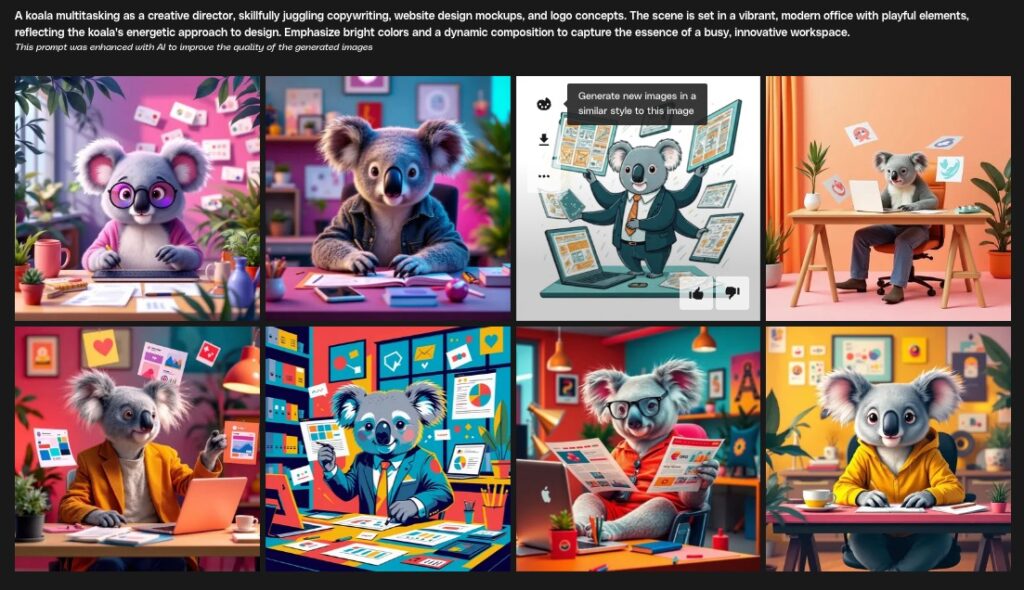
If one style catches your eye but isn’t perfect, you can click on any image and select “Generate new images in a similar style to this image.” This feature lets you iterate on promising directions without starting from scratch. It’s perfect for refining mascot branding concepts that are close but not quite there.

Using ImageEdit, we removed the busy background to create a cleaner, more versatile mascot that could work across different applications. The upscaling feature ensured the final image was crisp enough for digital and print use.

And with GraphicsGen, you can take the next step and create 3D graphics, or even merch-related graphics like a pin.
Simply type in your prompt to create a mascot you like, and select from 100 illustration styles. Here’s one we created using the “soft 3D mascots” style and the simple prompt “koala climbing on a tree for a brand mascot.”

You can of course experiment to create the exact look you want for your brand. And if you already have a sketch or image you want to use, simply upload it to GraphicsGen and apply the graphic style of your choice. Simple! Here’s our cute koala mascot on a metal pin, using the same prompt but with the “pinlay” style:

This AI-first approach to brand mascot design removes the most significant barrier to starting: the fear of the blank page. In just a few minutes, we went from a general concept to a polished mascot that captures our agency’s personality. You can just picture this one on social media, right?

The Envato library offers even more options if you want to take your design to the next level. You can approach mascot branding in complementary ways that expand your creative possibilities beyond what AI alone can deliver.
There are two great ways to combine your ImageGen creation with traditional design assets:
A simple search for “koala” reveals the breadth of options available. The graphic templates category shows 185 professionally designed koala assets, ranging from minimalist logos to detailed illustrations. Each offers a different approach to mascot branding. Some focus on cute and approachable personalities, while others emphasize professionalism or adventure.

But the absolute goldmine appears when you dive deeper into the koala graphics collection. Here you’ll find everything from sticker packs to mascot-ready characters.
This variety means you can develop a complete brand mascot design system and create an entire family of assets that work across different marketing mascot materials.

The combination of ImageGen and Envato shows that you don’t have to be a designer to create effective mascot marketing. Use these tools as your creative foundation. Then, build a comprehensive mascot marketing strategy that spans every channel.
Your brand mascot doesn’t have to be the next Duolingo owl to make a real impact. The key is to start with a clear vision of your brand’s personality and then use Envato’s AI tools, like ImageGen, to explore the possibilities.
The most successful mascots feel authentic to their brands while adding an unexpected element. Whether you create a quirky character that drives social engagement or a sophisticated symbol, AI creativity and professional assets give you everything you need to compete with the biggest brands.
Ready to give your brand some personality? Start experimenting with Envato’s AI image generator. Your future customers are waiting to meet the character that will make your brand unforgettable. While you’re exploring mascot ideas, check out our guide to building a strong visual brand identity to make sure your new mascot fits into your overall brand strategy.
A strong mascot has a clear personality that matches the brand’s values, works consistently across every channel (from packaging to push notifications), and can participate authentically in wider culture — not just recite brand messages. It should feel like a character you’d recognize even without the logo.
Not every brand needs one, but for small businesses trying to stand out in a crowded market, a mascot is one of the most effective ways to build memorability without a huge marketing budget. It gives you a consistent visual voice for social content and packaging, and often generates the kind of organic engagement that paid media can’t buy.
Costs vary widely. A traditional custom mascot design from a studio can run from $2,000 to $20,000+, depending on scope and licensing. Using Envato’s AI image generator and graphics generator to prototype the concept and then finishing with library assets brings that entry cost down significantly — you can workshop a working concept for the cost of a subscription.
Yes, mascot concepts generated through Envato’s AI tools are covered under the standard Envato subscription license, which supports commercial use. Always check the specific license terms for your subscription and plan, and treat AI generations as a starting point that your team refines into a final design.
Ground the character in your brand’s core personality rather than in a passing visual trend. Trendy art styles date fast; a strong personality carries. Also plan for evolution — Duolingo’s Duo has been redesigned multiple times over the years while keeping the same character DNA. Build your mascot to be updated, not replaced.
Compare 10 digital painting and image editing tools, from AI-powered concepting to manual brushes, and build your ideal creative workflow.

How to replace objects, backgrounds, and text in your photos with Photoshop's Generative Fill — and when a browser-based AI editor beats it.

What's actually in a template download, which software you need to edit it, and how commercial licensing works for client projects.

Maximalism is back in a big way in 2026, with weird and wonderful nostalgia aesthetics resurfacing on social media. Wacky Pomo, or Wacky Postmodern, is a 90s design trend inspired by kids' game shows, animations and children’s packaging design. It’s exaggerated, extreme and super fun, but you’ll need to leave your good taste at the door to really get into it.

